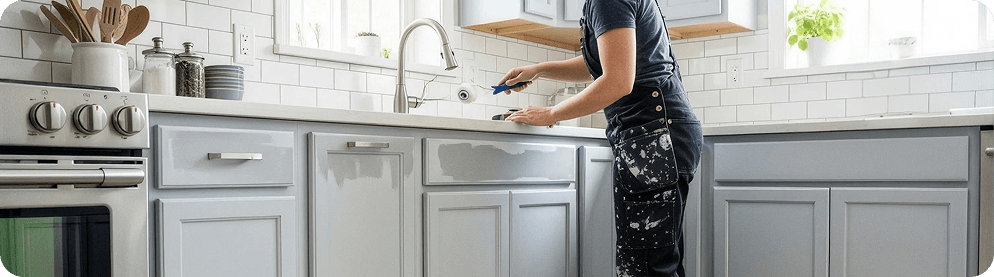
A weekend kitchen refresh sounds like the perfect DIY project. You buy a few gallons of retail paint, grab some brushes from the local home improvement store, and get to work. It seems like an easy way to save thousands of dollars.
But when it comes to kitchen cabinets, there is a massive difference between a project that looks good on social media and a finish that actually lasts.
Before you take your cabinet doors off their hinges, it is important to understand the hidden costs of a DIY cabinet project and why a factory-grade professional finish pays for itself in the long run.
1. The cost of time and disruption
Many DIY guides claim you can paint a kitchen over a single weekend. In reality, a proper cabinet transformation takes anywhere from 30 to 50 hours of intensive labor for an amateur.
Because you cannot rush drying and curing times, your kitchen becomes a construction zone for weeks.
- The DIY reality: your countertops are covered, your cabinet doors are spread across your garage or living room floor catching dust, and your kitchen is completely unusable for 7 to 14 days.
- The professional alternative: a dedicated crew handles the heavy lifting in a controlled environment, minimizing the chaos in your home and getting your kitchen back up and running in a fraction of the time.
2. The premium material and equipment gap
Achieving a smooth, brush-stroke-free finish requires specialized equipment. Standard rollers and brushes leave textures that ruin the sleek look of modern cabinetry.
To even attempt a professional look, a DIYer needs to invest in:
- A high-quality high volume low pressure (HVLP) or airless paint sprayer.
- Professional-grade respirators, heavy-duty drop cloths, and tactical masking tape.
- Specialized degreasers, wood fillers, and high-adhesion primers.
If you have to buy or rent all of this equipment, your "budget-friendly" project instantly costs hundreds of extra dollars before you even buy a single drop of paint.
3. The durability factor: retail paint vs. industrial coatings
Kitchen cabinets take more daily abuse than almost any other surface in your home. They are constantly exposed to moisture, steam, cooking oils, and physical impact.
Standard retail latex or oil based paints from local hardware stores are simply not engineered for this environment. They dry to a soft, flexible finish that easily chips, scratches, and stains under daily grease exposure.
Professional cabinet refinishers use industrial-grade coatings, such as post-catalyzed lacquers or polyurethane finishes. These products do not just dry; they chemically cure into a hard, factory-grade shell. This industrial coating creates a seamless layer that handles high traffic, repels oils, and cleans effortlessly without wearing away.
4. The risk of costly redos
The biggest risk of painting cabinets yourself is adhesion failure. If the cleaning, sanding, or priming steps are slightly off, the paint will begin to bubble, peel, or scratch off within six months especially around high touch areas like handles and trash drawers.
Fixing a failed DIY paint job is incredibly difficult. It requires chemically stripping or sanding down the failing paint layers, which takes twice as long as doing it right the first time. If the wood gets damaged during the stripping process, you might even have to replace the cabinet doors entirely.
The anatomy of a lasting finish
A flawless cabinet transformation is 80% prep work and 20% application. Missing just one step ruins the entire project:
- Deep degreasing: removing invisible cooking oils so the paint can bond.
- Precision sanding & profiling: creating a mechanical grip on the original wood or laminate.
- Flawless priming: applying specialized stain blocking primers to prevent wood tannins from bleeding through.
- Flawless spraying: applying multiple micro layers of industrial coatings in a dust-free environment.
The verdict: value that lasts
When you look at the true cost of DIY cabinet painting, you are not just calculating the price of the paint. You have to factor in your time, equipment costs, the disruption to your home, and the risk of a short-lived finish.
Investing in professional cabinet refinishing gives you a factory smooth, highly durable kitchen transformation without the stress. It upgrades your space, protects your cabinetry asset, and delivers a premium look that stands up to daily life for years to come.